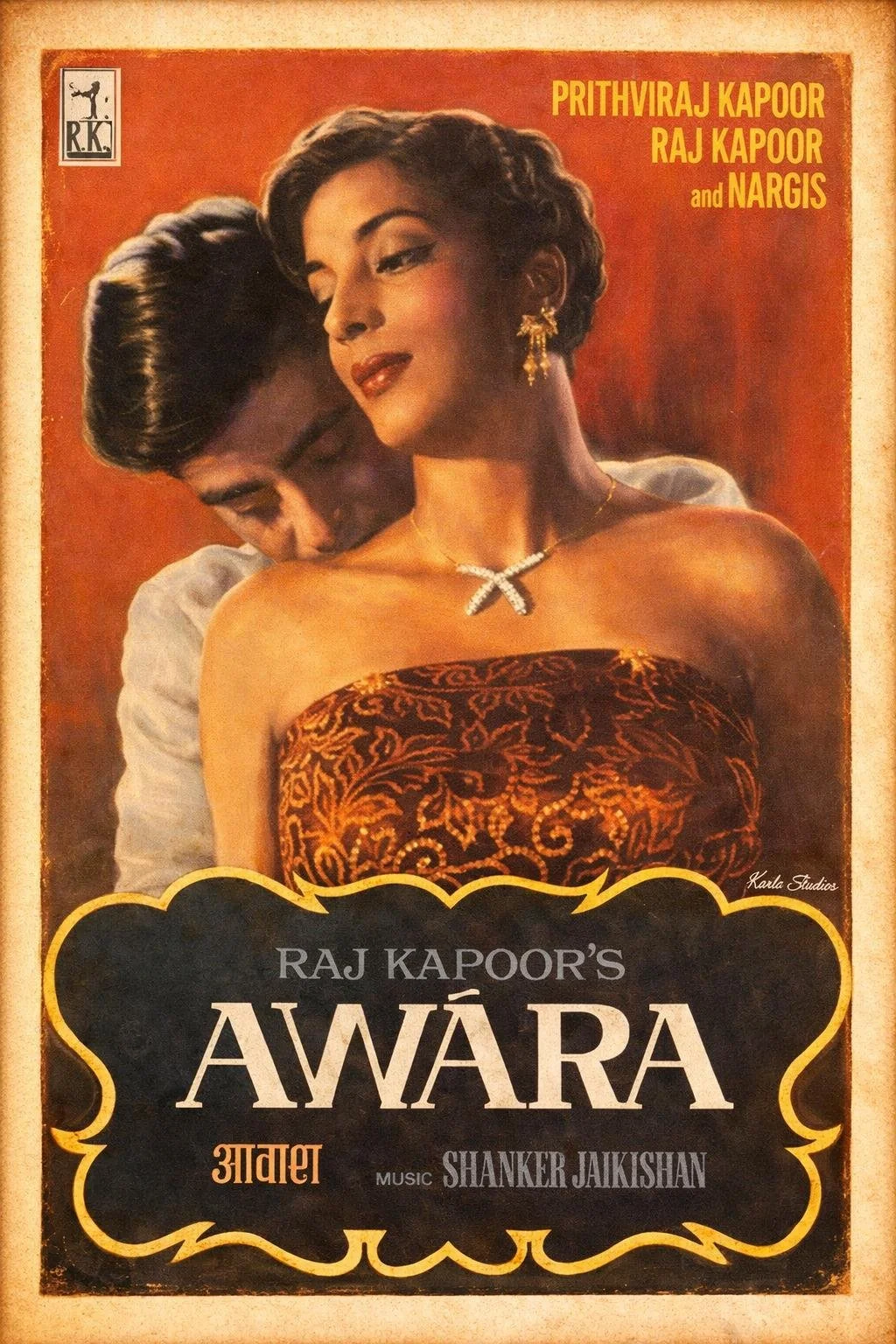
Relational Maps of World Cinema:
Awara as a Case Study
Created by Sigal Rona,
Centre for Cinema and Media Studies at Ghent University
This interactive map, currently in development by Sigal Yona, will chart the transnational journey of Raj Kapoor’s Awara (1951).
Its broader goal is to deepen our understanding of global film circulation and the varied ways cinema travels and transforms, moving beyond the established centers of Hollywood or European capitals. It seeks to shed light on the pulse points of world cinema—regions in the Middle East, the former Soviet bloc, Africa, and Asia—where Indian films have forged significant cultural and aesthetic connections. Awara’s immense popularity and enduring resonance across diverse societies make it a revealing lens through which to trace the dynamic flows of media, reception, and influence.
The map will link each node to archival artifacts to make visible the various connections that enabled Awara to circulate, be reinterpreted, and take on new meanings across regions. It currently includes five nodes—Cannes, Istanbul, Tel Aviv, Moscow, and Beijing—with more expected to be added.